How to delete specific messages from an ActiveMQ queue
Updated July 21, 2026
To delete one or more ActiveMQ messages, open the queue in QueueExplorer, find and select the intended rows, then choose Delete or press the Delete key. Use Purge only when every available message in the queue should be removed.
This guide applies to Apache ActiveMQ Classic. QueueExplorer does not currently support ActiveMQ Artemis.
Before deleting ActiveMQ messages
- Confirm the broker environment, virtual destination if applicable, and exact queue name.
- Determine whether the message is invalid, duplicated, expired in business terms, or simply delayed.
- Check whether the producer could send the same message again after deletion.
- Use an account authorized for the required message operation, not a broadly privileged shared account.
- Back up the selected messages when recovery may be needed.
If a message can be repaired or belongs on another destination, moving or exporting it is usually more useful than deleting it immediately.
1. Browse, filter, and select the messages
- Connect QueueExplorer to the ActiveMQ Classic broker.
- Expand Queues and click the source queue.
- Load a practical batch and filter by body text, JMS headers, or application properties.
- Inspect each candidate's content and properties, then select only the rows that should be removed.
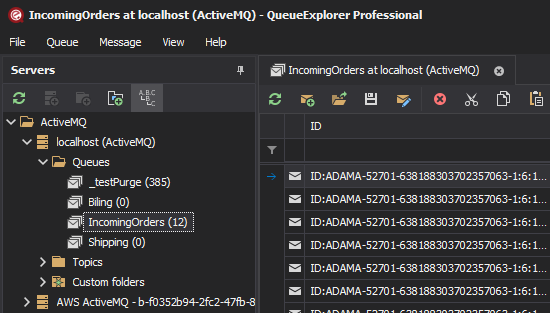
QueueExplorer filters the messages it has loaded; the broker does not provide a database-style full-text search over every message body. Increase the load limit carefully if the target is not in the first batch. QueueExplorer Professional can extract values from JSON, XML, or text payloads using JSON expressions, XPath, or regular expressions and expose them as filterable columns.
2. Delete the selected messages
With the intended rows selected, use the toolbar Delete command, choose Delete from the context menu, or press the Delete key. Review the confirmation carefully before proceeding.
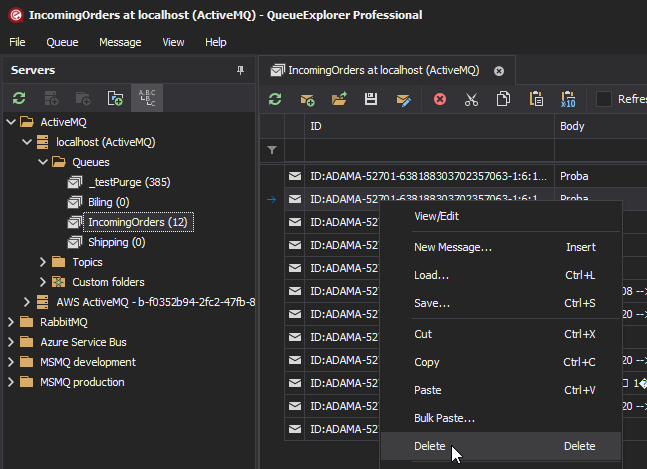
The queue can change between browsing and deletion. A consumer may receive a selected message, or a newly arrived message may alter the displayed order. Stop or pause consumers when you need a controlled maintenance window, then refresh immediately before selecting and deleting.
Delete every message with Purge
Right-click the queue and choose Purge when the goal is to remove all currently available messages. Purge is faster and clearer than loading a backlog and selecting every displayed row, but it is also much broader than selected deletion.
Messages already dispatched to consumers can be in flight rather than available in the queue view. Transaction rollback, consumer recovery, or a lost connection can return such messages later, so verify again after the maintenance window.
Deleting messages from an ActiveMQ dead-letter queue
A dead-letter queue is still a queue, so the same selected-delete and purge operations apply. ActiveMQ Classic commonly
uses ActiveMQ.DLQ by default, although its
dead-letter strategy
can be configured with individual dead-letter queues.
With a shared DLQ, first inspect the original-destination metadata and payload. Do not assume every message belongs to the same application or source queue. If the underlying failure has been corrected, consider moving selected messages back for reprocessing instead of deleting them.
Verify the result
- Refresh the source queue and confirm that the intended messages are gone.
- Check the queue count again after in-flight transactions and consumers have settled.
- Confirm that monitoring, retry logic, or the producer has not recreated the problem.
- Keep the backup until the application owner confirms the result.
Frequently asked questions
Can I delete one ActiveMQ message without purging the queue?
Yes. Browse the queue, identify the row by its body and properties, select it, and use Delete. Purge is a separate queue-wide operation.
Does deleting a message delete the queue?
No. Selected deletion and purge remove messages; they do not delete the queue definition.
Why did a deleted message appear again?
A producer may have sent a duplicate, or a previously dispatched message may have returned after rollback or recovery. Compare JMS and application identifiers, timestamps, and redelivery state before assuming it is the same stored copy.
Related ActiveMQ guides
- Browse and inspect ActiveMQ messages
- Move selected ActiveMQ messages to another queue
- Back up and restore ActiveMQ messages
QueueExplorer: a better way to inspect and manage ActiveMQ
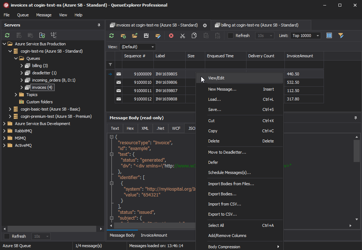
See what is happening in ActiveMQ and resolve message problems without writing one-off tools. Browse queues and live topics, inspect message contents, and manage your ActiveMQ Classic brokers from one desktop application. Try it free on Windows, macOS, or Linux.