How to back up and restore Azure Service Bus messages
Updated July 21, 2026
To back up Azure Service Bus messages with QueueExplorer, open the queue,
subscription, or subqueue, load a controlled batch, select the messages, and choose Save. QueueExplorer's
compressed .mq format stores multiple messages with their bodies and restorable properties. To
restore them, choose Load Messages on a destination queue or topic and select the file.
This is an operator-created message export, not a point-in-time snapshot of a live namespace. Azure Service Bus does not provide a general native backup-and-restore service for queued data, and producers, consumers, expiration, forwarding, or dead-lettering can change messages during an export.
For the definition workflow, see how to copy Azure Service Bus queues, topics, and subscriptions between namespaces.
Choose the right Azure Service Bus protection method
| Method | Protects | Use it for |
|---|---|---|
QueueExplorer .mq file |
Selected message bodies and restorable properties | Before cleanup, repair, replay, migration, or testing |
| Body export | Raw bodies in separate files, without full message metadata | Payload analysis with external tools |
| Schema export or infrastructure as code | Entities, subscriptions, rules, and configuration | Rebuilding topology or reviewing configuration changes |
| Premium Geo-Replication | Namespace metadata, message data, and message state in a secondary region | Regional resilience, not recovery from an accidental operator action |
1. Define the backup scope
- List every queue and topic subscription whose messages must be preserved.
- Include dead-letter, deferred, scheduled, transfer, and transfer dead-letter messages when relevant.
- Decide whether active consumers and publishers can be paused for a consistent boundary.
- Estimate the message count, total data size, maximum message size, and available local storage.
- Choose a protected destination and define how long the files will be retained.
- Record the namespace, entity, message state, export time, selection rule, and QueueExplorer version.
Do not automatically choose Show all on a large production entity. Start with a bounded batch and export in documented ranges if necessary. A long-running browse can use substantial client memory and increases the window in which the source changes.
When exact coverage matters, stop the relevant publishers and consumers, wait for in-flight locks to settle, then export and record the first and last Sequence Numbers. Service Bus browsing is not a transaction, so this operational pause is what creates a useful boundary.
2. Save full messages to a .mq file
- Open the queue, subscription, or required subqueue in QueueExplorer.
- Set the message limit to the controlled batch you intend to preserve and wait for it to load.
- Filter if the backup covers only a specific incident, customer, time range, or message group.
- Select the messages and choose Save, or press Ctrl+S/Cmd+S.
- Name the file with the namespace, entity, state, date, and batch number.
- Keep the file until you have tested that it can be loaded in a non-production environment.
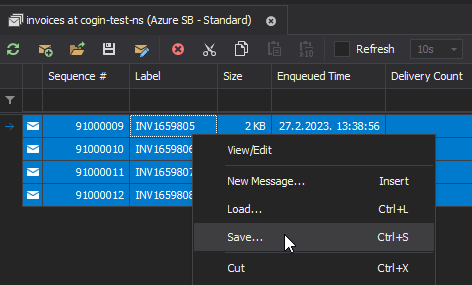
A .mq file is the preferred QueueExplorer backup when messages may be loaded again because it keeps
body data and applicable message properties together. Service-owned receive state still cannot be recreated
exactly: a restored message receives a new Sequence Number, Enqueued Time, and delivery state.
Free trial for Windows, macOS, and Linux
3. Export message bodies when metadata is not required
Choose Export Bodies to write each selected payload as a separate file. This is useful when JSON, XML, text, or binary content must be opened by other tools, searched with a file index, or supplied as diagnostic evidence.
Body files are not a full-fidelity message backup. Loading them later creates new messages without the original
Message ID, Correlation ID, Subject, Content Type, Session ID, TTL, application properties, and other metadata
unless those values are reconstructed separately. Use .mq alongside body exports when replay is possible.
How to restore Azure Service Bus messages
- Restore or verify the destination queue, topic, subscription rules, and settings first.
- Test the file against a non-production queue with equivalent session and duplicate-detection settings.
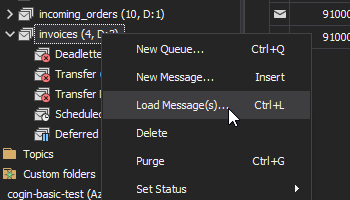
- In QueueExplorer, right-click the destination queue or topic and choose Load Messages.
- Select the
.mqfile and review any Session ID or message options. - Load a small canary batch, then inspect its bodies and properties at the destination.
- Run one consumer instance and verify downstream side effects before loading the remainder.
- Record old-to-new Sequence Number ranges and retain the backup until reconciliation is complete.
What cannot be restored exactly
- Sequence Number, Enqueued Time, Delivery Count, lock token, and current lock state;
- the original position among messages that arrived before or during the restore;
- a past absolute expiration time that is no longer valid;
- the fact that a message was deferred, scheduled, dead-lettered, or in transfer state unless it is restored through a deliberate equivalent workflow; and
- topic subscription placement without resending through the topic's current rules.
Restoring to a topic can create a copy in every currently matching subscription. Restoring a preserved Message ID to an entity with duplicate detection can suppress the new copy if that ID is still inside the detection window.
Back up every relevant message state
- Active queues and subscriptions: export each entity separately and record Sequence Number coverage.
- Dead-letter: preserve dead-letter reason and description as part of the incident evidence.
- Deferred: record Sequence Numbers; deferred messages are retrieved for processing by number.
- Scheduled: record scheduled enqueue time and the scheduled-state Sequence Number before cancellation or rescheduling.
- Sessions: preserve Session ID on every message and export session state separately; session state is not just another queued message.
- Transfer and transfer dead-letter: include them when auto-forwarding is part of the message path.
Protect the backup files
- Treat message bodies and properties as production data that may contain credentials, personal data, or commercial records.
- Store exports on encrypted media with access controls and audit logging.
- Do not attach raw message files to tickets or email unless policy explicitly permits it.
- Hash files and keep a manifest when integrity must be demonstrated.
- Apply a retention and secure-deletion policy; a backup should not become an unmanaged permanent copy.
Backup versus Geo-Replication and Geo-Disaster Recovery
Microsoft states that Service Bus is designed for transient message storage and does not provide general long-term message backup and restore. For durable history, archive business events in Azure Storage, a database, or another system designed for retention.
Azure Service Bus Premium now offers two different regional features:
- Geo-Replication replicates namespace metadata, message data, and message state to a secondary region. It improves regional resilience but also replicates destructive state changes, so it is not an operator-undo archive.
- Geo-Disaster Recovery replicates metadata only. Messages are not copied to the secondary namespace.
Availability zones and broker replicas protect service availability; they do not let you roll a queue back to a chosen time after an application consumes messages or an operator deletes them.
Frequently asked questions
Does Azure Service Bus have native message backup and restore?
No general point-in-time backup and restore is available for queued data. Premium Geo-Replication protects against regional failure, while QueueExplorer exports provide a separate recovery artifact for selected messages.
Can I back up a live Azure Service Bus queue consistently?
Browsing is not a transactional snapshot. For a defined boundary, pause publishers and consumers, allow in-flight locks to settle, export in recorded batches, and verify Sequence Number coverage.
Does a message backup include queue and subscription settings?
No. Export the schema separately or keep it in infrastructure as code. Messages alone do not reproduce topic rules, forwarding, sessions, duplicate detection, TTL, or dead-letter settings.
Will restored messages have the same Azure Service Bus metadata?
Application-controlled properties can be preserved, but the destination assigns new service-owned values such as Sequence Number and Enqueued Time.
For the next step, read how to move selected messages safely or delete a reviewed selection.
QueueExplorer: a better way to inspect and manage Azure Service Bus
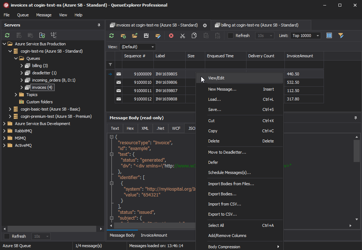
See what is happening in Azure Service Bus and resolve message problems without writing one-off tools. Browse queues and topic subscriptions, inspect message contents, and manage your Azure Service Bus environment from one desktop application. Try it free on Windows, macOS, or Linux.